Overview
FunFlux is a Snakemake workflow for fungal isolate genome analysis. It accepts Illumina reads, Oxford Nanopore (ONT) or PacBio HiFi reads, short and long reads from the same isolate, or an existing assembly. The workflow combines assembly, contamination and mitochondrion screening, quality control, ITS-based taxonomy, repeat masking, gene prediction and functional annotation.
FunFlux was developed for the genomic characterisation of fungal isolates. Its results describe the assembled genome, its predicted genes and their functional annotation, including the secondary-metabolite gene clusters found by antiSMASH. They are predictions from the genome sequence, to be weighed with curation and experimental evidence.
An optional screen looks for the point mutations that the FungAMR database lists with evidence
for or against resistance to antifungal drugs and fungicides. The configuration key mode selects
the input mode. This site documents version v2.1.0.
FunFlux belongs to the BioFlux family of pipelines.
Terms used on this page
| ONT | Oxford Nanopore Technologies, a long-read sequencing platform |
| HiFi | PacBio's accurate long reads, each the consensus of several passes over one molecule (CCS) |
| ITS | internal transcribed spacer — the rDNA region used as the barcode of fungi |
| BUSCO | a set of single-copy genes expected in every genome of a lineage, used to estimate completeness |
| soft-masking | writing repeats in lower case, so that gene finders can treat them differently without losing the sequence |
| AMR | antimicrobial resistance; in FunFlux, point mutations studied for resistance against antifungal drugs and fungicides |
The workflow at a glance
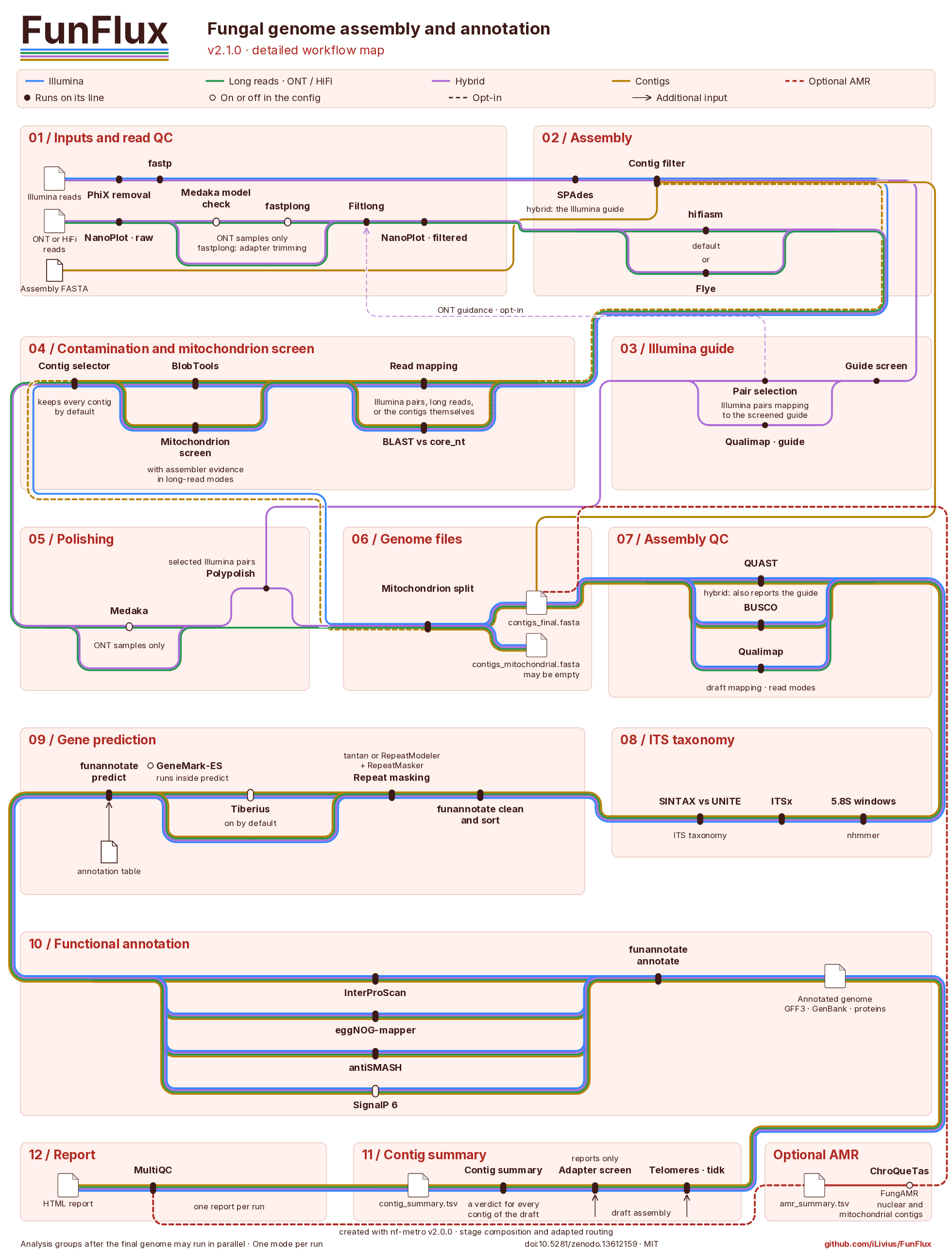
Each coloured line is one mode: follow yours from its input to the report. The four lines take
their own routes to contigs_final.fasta, the genome every mode delivers, and from there run on
together through the analyses. In hybrid the purple line has two arms: the Illumina arm builds a
guide assembly with SPAdes, screens it and keeps the Illumina pairs that map to it, and Polypolish
uses those pairs to correct the long-read assembly. In contigs mode the solid gold line goes
straight to contigs_final.fasta; the dashed gold path is the contamination and mitochondrion
screen, which the configuration can switch on. Where the lines split into parallel tracks, the
steps run side by side. Analysis groups after the final genome may run in parallel. The order
along the line is a reading order, not the order in which the steps must run. An open ring marks a
step the configuration switches on or off. The Medaka model check, fastplong (adapter trimming)
and Medaka apply to ONT samples only; HiFi reads pass them by. GeneMark-ES, marked beside
funannotate predict, runs inside it when it is switched on. Thin lines are extra inputs, and the
dashed red line is the optional resistance-mutation screen.
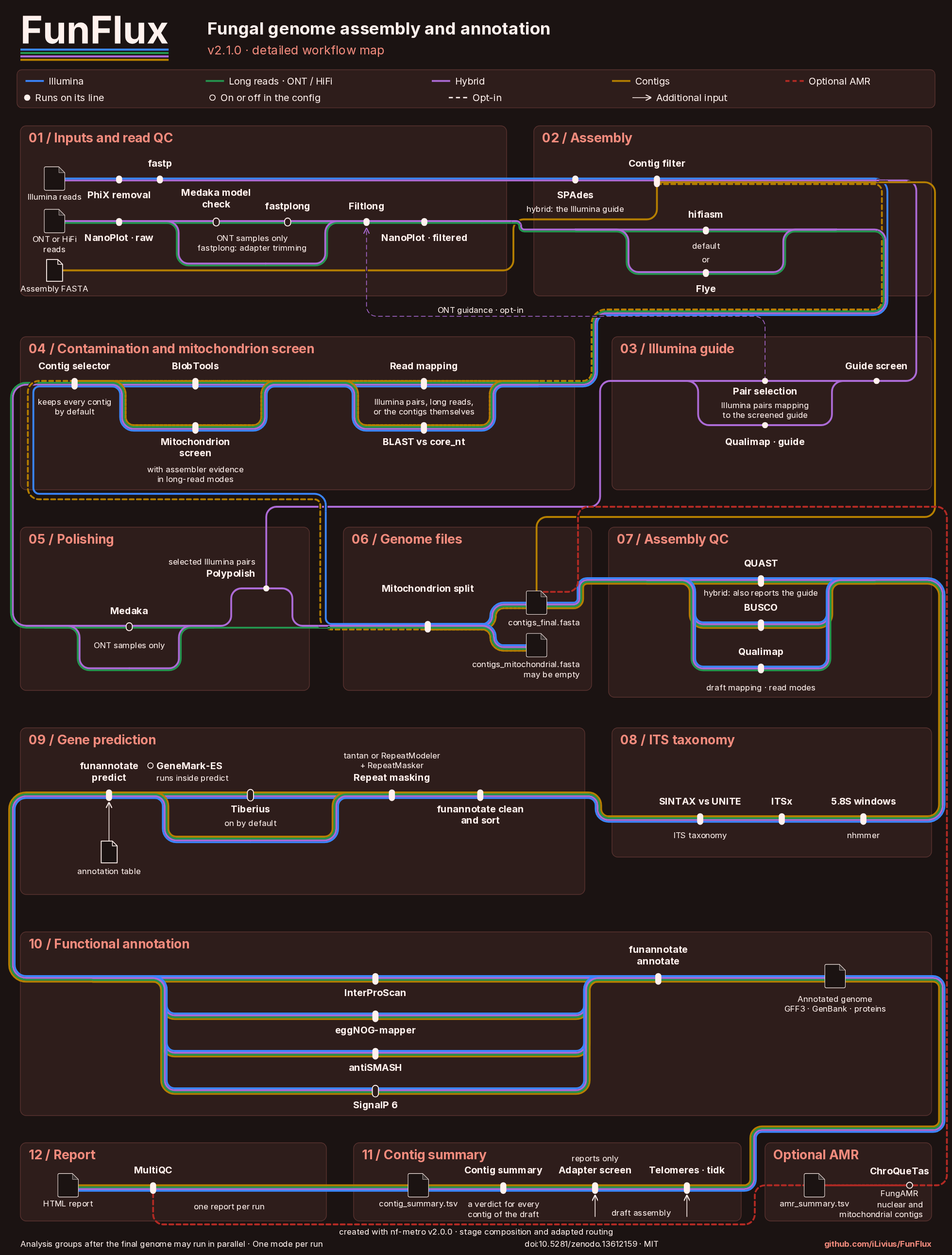
Select the map to open it larger; select it again to see it at full size, and close it with × or Esc.
The stages, their tools and when they run:
| Stage | Tools | Runs |
|---|---|---|
| Assembly | depends on the mode (below) | illumina, longread, hybrid; contigs mode starts from your assembly |
| Contamination screen | BLAST against NCBI core_nt, BlobTools | always; in contigs mode only when the screen is switched on |
| Mitochondrion screen | BLAST, with the assembler's evidence in the long-read modes | with the contamination screen |
| Assembly QC | QUAST, BUSCO | always |
| Contig summary | tidk finds the telomeres and BLAST+ screens for adapter sequence; one table per sample gives every contig of the draft a verdict (Contig summary) | always |
| ITS taxonomy | ITSx, SINTAX against UNITE | always |
| Repeat masking | tantan, or RepeatModeler and RepeatMasker | always |
| Gene prediction | funannotate with its own gene finders, Tiberius (on by default) and GeneMark-ES (with a licence) | always |
| Functional annotation | InterProScan, eggNOG-mapper, antiSMASH, SignalP 6 | always; SignalP 6 is optional |
| Antifungal resistance mutations | ChroQueTas against the FungAMR database | only when switched on |
| Report | MultiQC, one report for all samples | always |
From the contamination screen on, every mode runs the same steps. Only polishing differs between the read-based modes.
The four modes
illumina |
longread |
hybrid |
contigs |
|
|---|---|---|---|---|
| Input | Illumina paired-end reads, {sample}_R1.<ext> and {sample}_R2.<ext> |
ONT reads {sample}_ont.<ext> or PacBio HiFi reads {sample}_pacbio.<ext>; one batch may hold both |
Illumina pairs and ONT or PacBio HiFi reads for every sample | one assembly per sample, {sample}.fasta, .fa or .fna |
| Read QC | PhiX removal (bowtie2), then fastp | ONT adapters removed (fastplong); NanoPlot before and after Filtlong | both of the above | none |
| Assembly | SPAdes | hifiasm (default) or Flye | an Illumina guide assembly (SPAdes) to select the isolate's read pairs, then hifiasm or Flye on the long reads | no assembler |
| Contig filter | ≥ 500 bp and ≥ 2× coverage, read off SPAdes' own headers | none | the same cut-offs, on the guide assembly only | the same cut-offs when the headers are SPAdes-style; otherwise headers are cut at the first space or tab and nothing is removed |
| Adapter screen | the draft contigs are searched for adapter and barcode sequence (BLAST+); reported, nothing removed | the same | the same | the same |
| Polishing | none | Medaka, ONT samples* | Medaka (ONT samples*), then Polypolish with the Illumina pairs | none |
| Delivered genome | the screened SPAdes contigs | the screened long-read assembly, polished with Medaka for ONT samples | the screened long-read assembly, corrected with the Illumina pairs | the input contigs, screened only with parameters.contigs.screen: true |
* Medaka is on by default for ONT samples, and medaka_model: false switches it off. PacBio HiFi
samples are never polished with Medaka. <ext> is fastq, fq, fastq.gz or fq.gz, the same
for all files of one kind in a batch, and _pacbio files must hold HiFi (CCS) reads. CLR reads are not
supported.
hybrid requires more computation than either single-technology mode, because it assembles and
screens the Illumina reads as well. In hybrid, Filtlong can also score the ONT reads against
the selected Illumina pairs, but only when short_read_guidance is switched on. If you used
FunFlux 1.x, Funnotator or FunFluxL, Coming from v1 lists what
changed. See Modes and Choosing a mode.
Delivered genome files
Every sample ends with up to three FASTA files in 02.assembly/{sample}/. Their content depends
on two settings: whether the contamination and mitochondrion screen runs, and
parameters.mitochondria.mode. The screen always runs in illumina, longread and hybrid, and
in contigs mode only with parameters.contigs.screen: true.
| File | Screen on, mitochondrion split off (separate_confirmed, the default) |
Screen on, parameters.mitochondria.mode set to off or report |
contigs mode without the screen |
|---|---|---|---|
contigs_all.fasta |
the assembly after the contamination screen and, in longread and hybrid, after polishing; mitochondrion included |
the same | not written |
contigs_final.fasta |
the nuclear genome: contigs_all.fasta without the confirmed mitochondrial contigs |
every contig | the input after the contig filter, including a mitochondrial genome if the input contains one |
contigs_mitochondrial.fasta |
the confirmed mitochondrial contigs; an empty file when none was confirmed | an empty file | not written |
contigs_final.fasta is the genome that QC, ITS and annotation read
QUAST, BUSCO, the ITS extraction and funannotate run on contigs_final.fasta. It is the
nuclear genome alone only when the screen runs with the default separate_confirmed.
Otherwise nothing is split off.
The gene models refer to a renamed copy of that genome. funannotate clean and
funannotate sort turn contigs_final.fasta into 04.annotation/{sample}/contigs_sort.fasta,
whose contigs are named scaffold_1, scaffold_2, ... from the longest down, and the gene
models use these names. QUAST, BUSCO and the ITS files keep the names of contigs_final.fasta.
contigs_removed_by_clean.txt, next to contigs_sort.fasta, lists the contigs
funannotate clean removed.
One command, one configuration, one report
All four modes are launched the same way, from the repository root:
--sdm conda builds the conda environment of each rule on first use. Besides Snakemake, you
obtain InterProScan yourself, and the optional GeneMark-ES and SignalP 6 if you use them
(Licensed and external tools). --cores sets the CPU budget
of a local run and is used without --jobs. See Running FunFlux.
Pass the configuration file explicitly with --configfile. FunFlux ships a template,
config/config.yaml, but does not load it on its own: copy it, then set the mode, the input and
output paths, the database locations and the annotation table. A wrong mode, a missing input
directory, a bad sample name or a missing annotation row stops the dry run before any job starts.
See Configuration and Quick start.
Results are written to numbered folders that are the same in every mode: 00.resources for
material shared by the samples of a run, 01.reads (not in contigs mode), 02.assembly,
03.taxonomy, 04.annotation, 05.amr (only with the resistance-mutation screen on),
06.report and logs. The funannotate database stays in directories.funannotate_db, outside
the output folder. Every run ends with a MultiQC report,
06.report/multiqc_report.html, which collects the QC of all samples. The annotation itself is
in 04.annotation/{sample}/funannotate/annotate_results/. See
Output files.
What has to be prepared in advance
FunFlux installs its own software, but three resources must be on disk before the first run:
NCBI core_nt with its taxonomy files (not read in contigs mode without the screen), the
eggNOG-mapper data, and an InterProScan installation. GeneMark-ES and SignalP 6 are optional
and need a licence. Everything else is downloaded on first use, or can be pointed at a copy
you already hold. See Reference databases and
Licensed and external tools.
Where the resistance-mutation screen fits
Stage 05.amr is disabled by default (parameters.amr.chroquetas: off). When enabled,
ChroQueTas searches each genome for the point mutations that the FungAMR database lists with
evidence for or against resistance to antifungal drugs and fungicides, and FunFlux summarises for each sample the
known changes found and the drugs FungAMR links them to. A sample of a species that FungAMR does
not cover is reported as not screened.
These calls describe known mutations in the genes and species that FungAMR covers. They do not establish a resistance phenotype, and the absence of a call is not evidence of susceptibility. Interpret them together with the evidence levels FungAMR gives each mutation. See Antifungal resistance mutations.
Where to go next
| Page | Read it for |
|---|---|
| Choosing a mode | which mode a dataset belongs in, and how to name the input files |
| Installation | Snakemake (9.14.6 or a later 9.x; tested with 9.14.6), the repository and the conda environments |
| Reference databases | what to download before the first run, and what FunFlux fetches |
| Licensed and external tools | InterProScan, which every run needs, and the optional GeneMark-ES and SignalP 6 |
| Quick start | the commands from a filled-in configuration to a finished run |
| Configuration | every configuration key, the modes that read it, its default and allowed values |
| Running FunFlux | the dry run, CPU cores and threads, resuming an interrupted run, running on a cluster |
| Troubleshooting | what a [FunFlux] message or a failed step means, and what to do |
| Validation on public genomes | what each read-based mode produced on Botrytis cinerea B05.10, what PacBio HiFi reads of Cordyceps cateniannulata GXU-8616 gave, and how to repeat the runs |
FunFlux is released under the MIT License; the tools and databases it calls carry their own terms, listed on Licensing.