Comparing learners
TabPFN, a random forest and XGBoost in the full run: the same 3,680
samples, five grouped folds, nested selection and tuning. Every number below comes from
that run's metrics/ folder: log-loss as the run reports it, everything else recomputed
from the saved out-of-fold probabilities (metrics/oof_predictions.csv). The tables and
figures on this page come from scripts/make_cfmd_comparison.R, applied to the run
folder:
Rscript scripts/make_cfmd_comparison.R out/<run>_saved_learners out/comparison
The decision rule
A learner returns one probability per category. Two rules turn that into a prediction:
- largest probability;
- largest probability divided by the category's frequency in the training samples:
TabFlux's default (
evaluation.prior_correction), applied per outer fold with that fold's training frequencies.
Both columns below come from the same saved probabilities, so log-loss is the same for both rules. Mean over the five folds, ± the standard deviation across them:
| balanced accuracy, largest probability | balanced accuracy, default rule | accuracy, largest probability | accuracy, default rule | log-loss | |
|---|---|---|---|---|---|
| TabPFN | 0.621 ± 0.118 | 0.662 ± 0.121 | 0.823 | 0.801 | 0.572 ± 0.118 |
| Random forest | 0.552 ± 0.128 | 0.626 ± 0.157 | 0.807 | 0.743 | 0.677 ± 0.163 |
| XGBoost | 0.582 ± 0.098 | 0.634 ± 0.103 | 0.805 | 0.801 | 0.565 ± 0.177 |
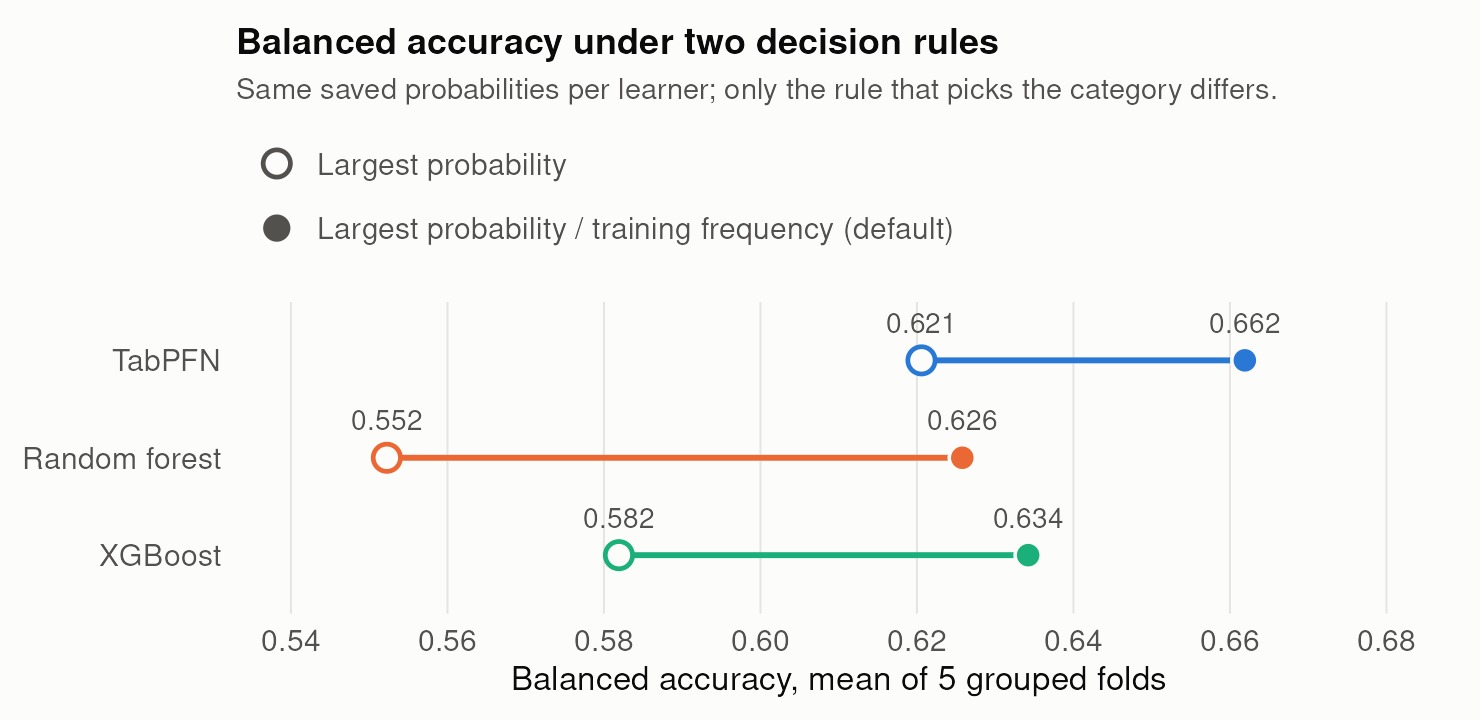
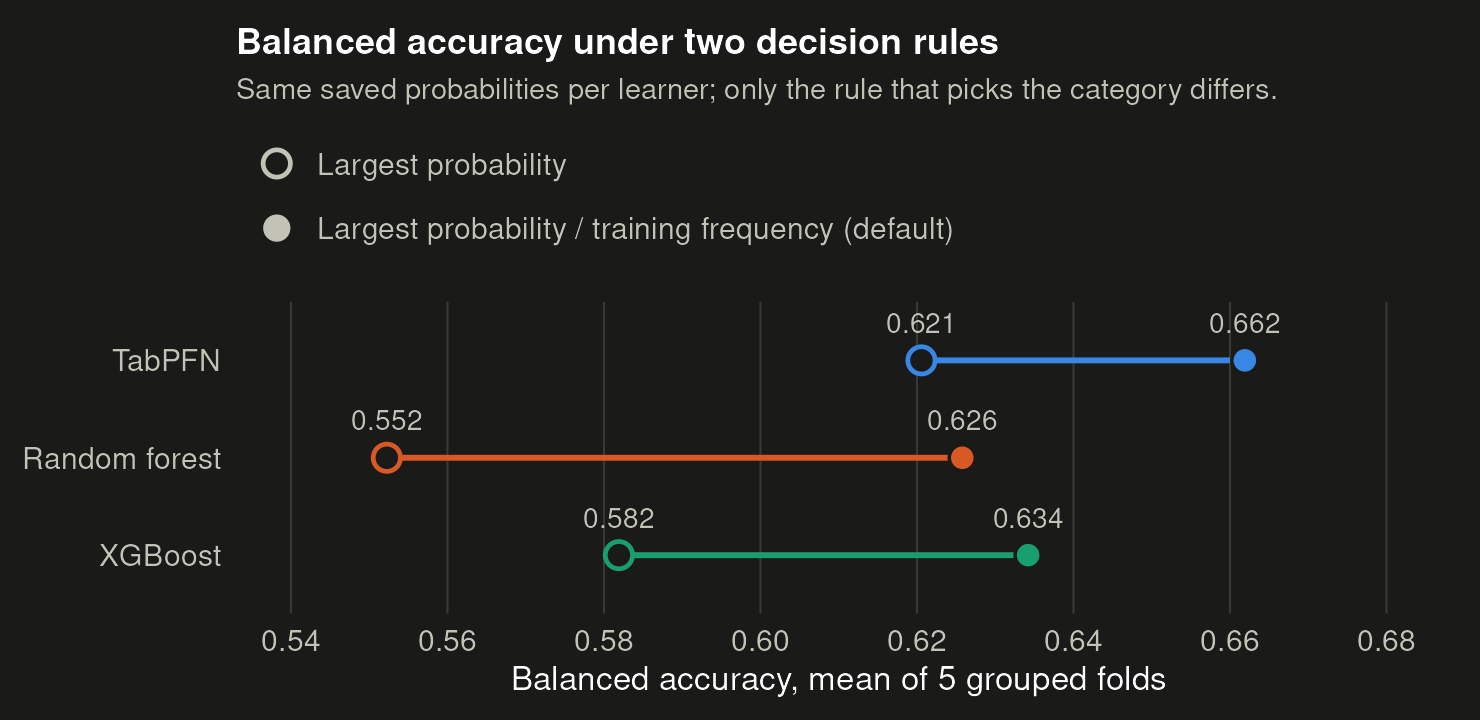
- The rule moves each learner more than the learners differ: +0.041 (TabPFN), +0.074 (forest), +0.052 (XGBoost), against a gap of 0.028 between the first and second learner under the default rule.
- The cost is accuracy, through dairy recall: the forest loses 0.064 accuracy (dairy recall 0.998 → 0.843), TabPFN 0.022, XGBoost 0.004.
- Rules must match across learners. TabPFN has the same correction built in
(
balance_probabilities). With it on and the trees on the largest probability, the comparison reads 0.662 against 0.552 and 0.582: most of that gap comes from the rule, not the learner. TabFlux turns TabPFN's option off and applies its own rule to every learner.
Per category
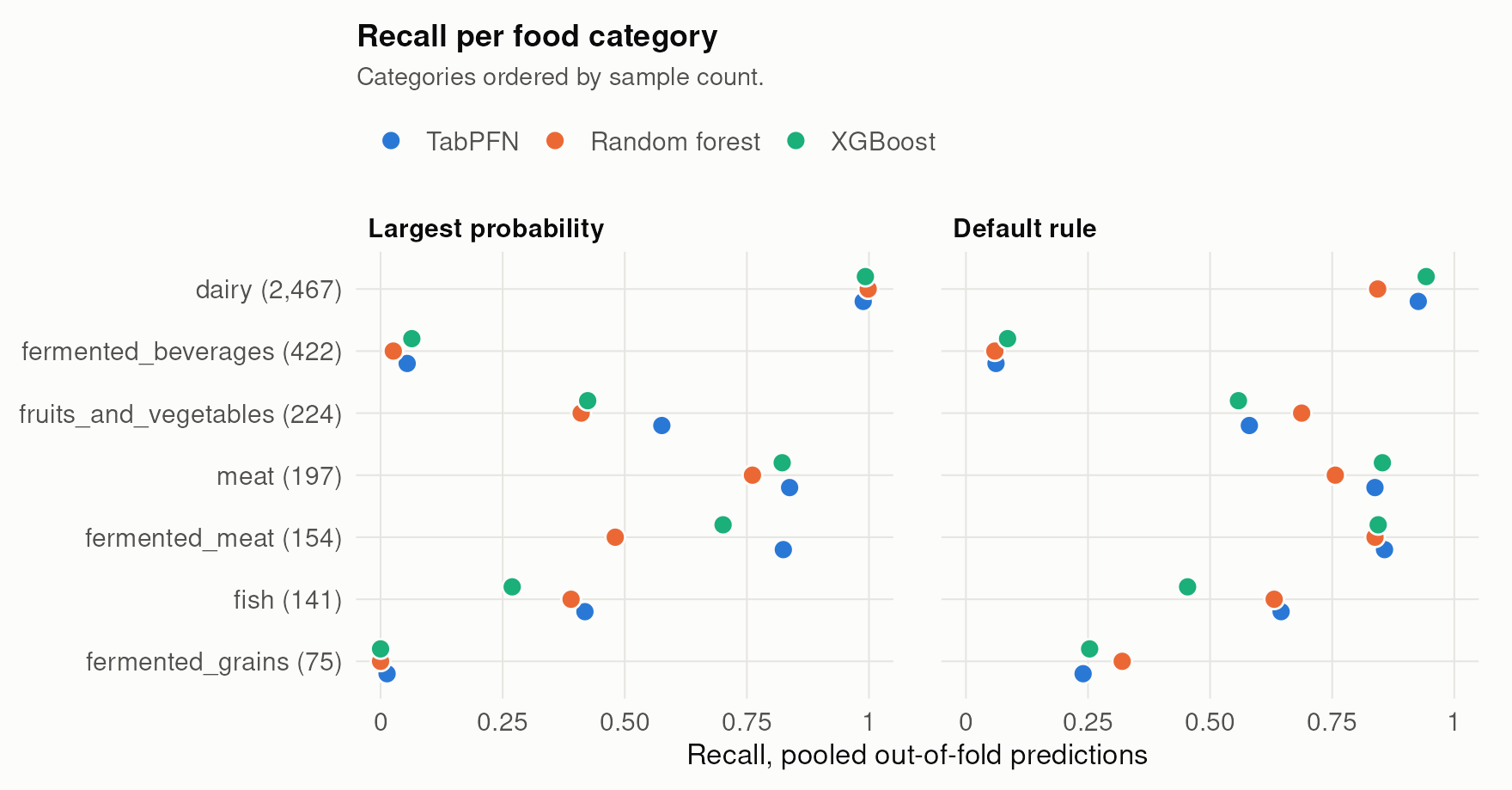
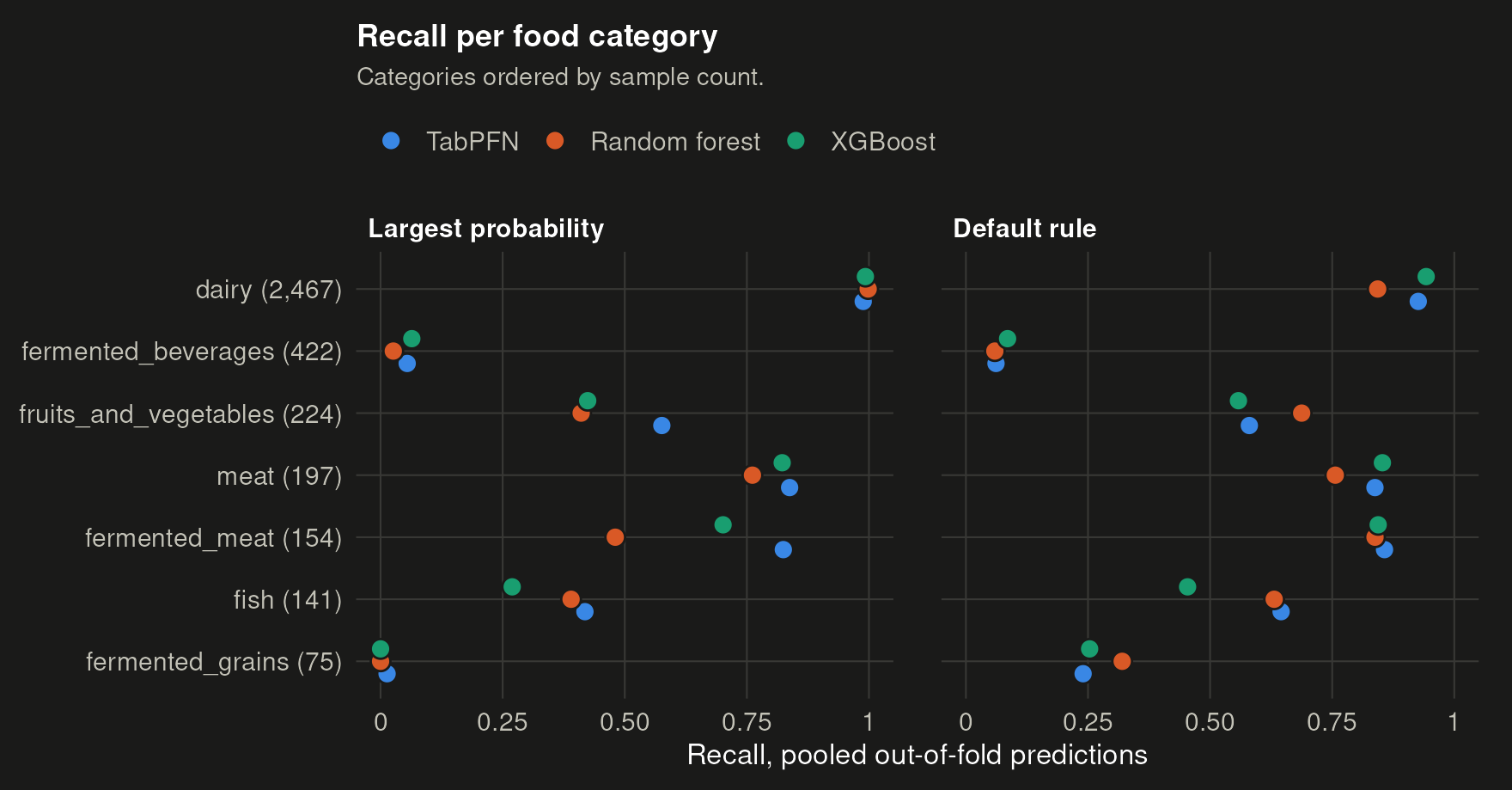
Pooled recall over the out-of-fold predictions, largest probability → default rule.
| category | n | TabPFN | random forest | XGBoost |
|---|---|---|---|---|
dairy |
2,467 | 0.988 → 0.926 | 0.998 → 0.843 | 0.993 → 0.942 |
fermented_beverages |
422 | 0.055 → 0.062 | 0.026 → 0.059 | 0.064 → 0.085 |
fruits_and_vegetables |
224 | 0.576 → 0.580 | 0.411 → 0.688 | 0.424 → 0.558 |
meat |
197 | 0.838 → 0.838 | 0.761 → 0.756 | 0.822 → 0.853 |
fermented_meat |
154 | 0.825 → 0.857 | 0.481 → 0.838 | 0.701 → 0.844 |
fish |
141 | 0.418 → 0.645 | 0.390 → 0.631 | 0.270 → 0.454 |
fermented_grains |
75 | 0.013 → 0.240 | 0.000 → 0.320 | 0.000 → 0.253 |
- Largest probability: all three keep ≥ 0.988 of dairy and recall at most 1 of the 75
fermented_grainssamples. - Default rule:
fermented_grains0.24–0.32,fish0.45–0.65, dairy 0.84–0.94. - The forest gains most from the rule on
fermented_meat(0.481 → 0.838) andfruits_and_vegetables(0.411 → 0.688). fermented_beveragesstays below 0.09 under both rules: most of its samples are one dataset that none of the learners transfers to (results).
Per fold
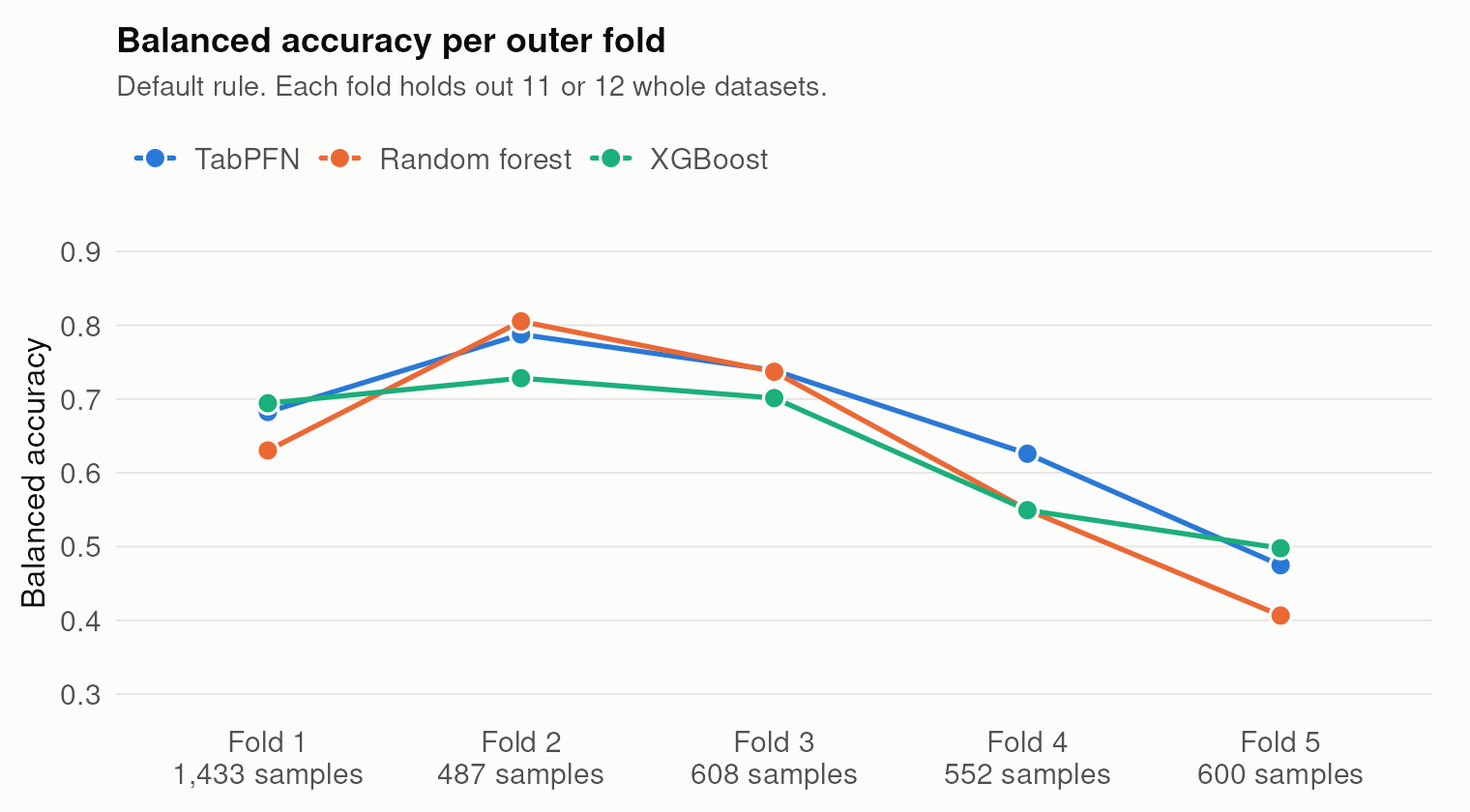
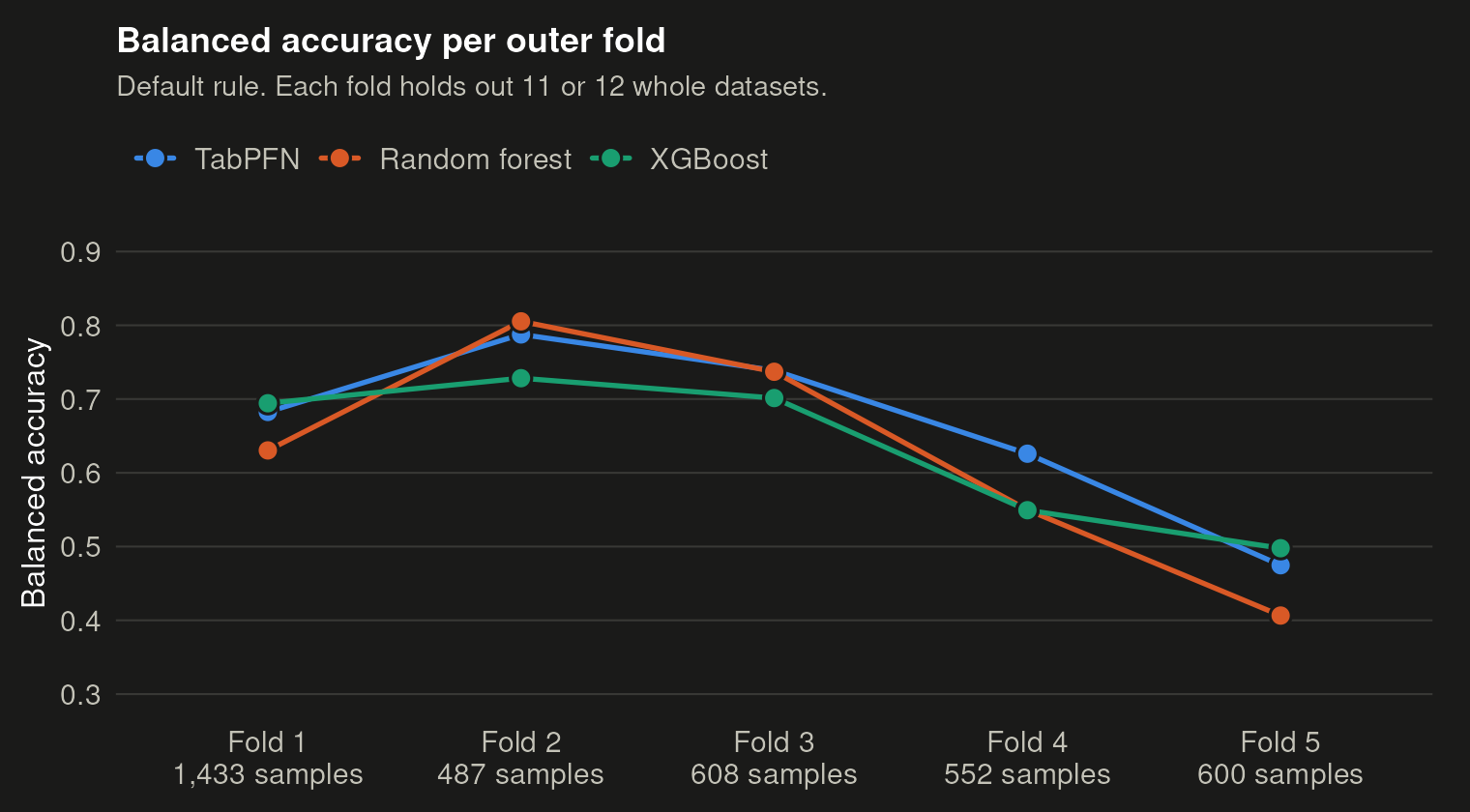
Paired differences in balanced accuracy, default rule:
| fold | n test | TabPFN − forest | TabPFN − XGBoost |
|---|---|---|---|
| 1 | 1433 | +0.052 | −0.012 |
| 2 | 487 | −0.018 | +0.059 |
| 3 | 608 | +0.002 | +0.037 |
| 4 | 552 | +0.076 | +0.077 |
| 5 | 600 | +0.068 | −0.023 |
| mean | +0.036 | +0.028 |
- TabPFN is ahead of the forest in four folds and of XGBoost in three.
- Five paired differences from folds that share training data: too few to call a winner.
- Fold means run from 0.46 to 0.77. Which datasets are held out moves the score more than which learner is used.
XGBoost's configuration
Settings that decide what XGBoost can reach here (learners and tuning):
| setting | value | why |
|---|---|---|
| tuner | random search, 80 settings (40 with fast_tuning) |
early stopping sets the number of rounds, so there is no budget for Hyperband to grow |
| boosting rounds | early stopping on a 20 % validation slice, 10 rounds of patience, at most 1,000; final refit on the inner folds' mean | the right number depends on eta; early stopping finds it per fit |
eta |
0.01–1, log scale | below 0.01, 1,000 rounds cannot move the model far from its starting score |
| decision rule | default rule, as for every learner | see above |
- The
etafloor: a log-scale range reaching down to 1e-4 would put half the draws below 0.01, where they are wasted; the floor at 0.01 spends every draw on a rate that can learn within 1,000 rounds. - With these settings XGBoost has the lowest log-loss of the three, 0.565, and the smallest fold-to-fold spread in balanced accuracy, ± 0.103.
Limits of this comparison
- One run, five folds, folds that share training data. A difference of 0.03 in balanced accuracy is inside the fold-to-fold spread and does not rank the learners.
- The largest-probability columns are recomputed from models that were tuned and whose features were selected under the default rule. Tuned and selected under the largest-probability rule, the models could differ.
- Per-category recall rests on few datasets per category:
fermented_grainson three,fermented_beveragesmostly on one.